About Communication Passports
What is a Communication Passport?
Communication Passports are portable documents that accompany children who have difficulties communicating wherever they go. Communication Passports provide essential information about a child or young person to the reader, to enable communication and understanding. They can help when children start or change school, access respite care, or go to hospital.
Passports aim to:
- Present the person positively, as an individual.
- Provide a place for the person’s own views and preferences to be recorded and drawn to the attention of others.
- Reflect the person’s unique character, sense of humour, likes and dislikes.
- Describe the person’s most effective means of communication and how others can best communicate with and support the person.
- Draw together information from past and present, and from different contexts, to help staff and conversation partners understand the person and have successful interactions.
- Place equal value on the views of all who know the person well, as well as the views of the specialist professionals.
The advantage of a Communication Passport is that it is easy to read, informative, useful, and fun. Passports are used in home, care, social work, health and education settings and aim to bring together information from all of those different settings. Passports are useful for a very wide range of people.
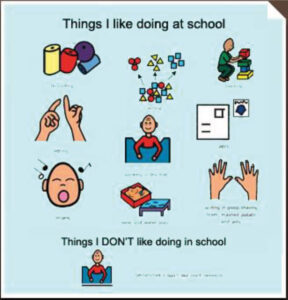
A typical Communication Passport would contain the following sections:
- All about me – Who am I?
- Important things about me
- My Family
- My Friends
- Special people, special things
- Things you need to know about me
- How I communicate
- My personality
- Fun things I like to do
- Places I like going
- Things I don’t like
- I’m good at
- Things I need help with
- What I like to eat and drink
- What I don’t like to eat and drink
Benefits of a Communication Passport to a child or young person:
Communication Passports:
- Help others to quickly find out what the child or young person’s communication methods and preferences are. This means that all the adults involved with caring for the child or young person have access to the most up-to-date information and this helps to ensure the appropriate care and support is given.
- Travel with the child or young person wherever they go. o GP surgery
- Hospital
- School
- Sports/Social clubs
- Where possible, the child or young person helps to create and update the Passport.
- As the child or young person grows up and develops, the Communication Passport is updated.
Benefits to others who read the Communication Passport:
- Helps staff, related agencies, and conversation partners to get to know the young person with communication disabilities.
- Enables staff to interact and respond consistently to help the person make sense of events and interact effectively.
- Ensures inter-agency planning and working which improves the consistency and continuity of provision.
- Allows supply staff, new staff and volunteers who come into contact with the student, to obtain key information that ensures effective communication.
- Makes visits to hospitals and other institutions smoother through the up-to-date provision of personal information.
- Aids assessment through and helps identify any gaps in care provision.
- At times of transition, it is critically important, as new people have to get to know and understand the child or young person accurately and quickly.